v1.22.0
2026-10-13
Restaurant Group POS: tables, kitchens, recipes and online orders for restaurant chains
- Outlets with their kitchen stations and tables, one menu for every outlet with veg marks, calories and allergens, outlet prices from a date, and dishes sold out for the day.
- Captains take orders at the table; each dish goes to its own kitchen station as a numbered KOT. The kitchen screen shows tickets oldest first and the captain sees what is ready to serve.
- A dish already sent to the kitchen is cancelled only by a manager, with the reason and whether it was cooked. Tables move, merge and split, and the bill is paid at the counter with a GST invoice.
- Every dish has a recipe: selling it draws its ingredients from the outlet's kitchen store, so food cost is known by outlet and by day. Wastage and staff meals are recorded with their reason.
- A central kitchen makes gravies, doughs and bases from their recipes, at exactly what they cost, and sends the outlets what they ask for.
- Each outlet has its own ordering page, paid on your own Razorpay or Cashfree or when collected. Swiggy and Zomato orders are billed to the app with no GST (section 9(5)) and reported in GSTR-1 table 14.
- A restaurant board shows outlet sales, spend per guest, food cost and food cost %, wastage, dishes cancelled and tables seated now.
v1.21.2
2026-10-14
Job costs for made-to-order work, and pharma batch records
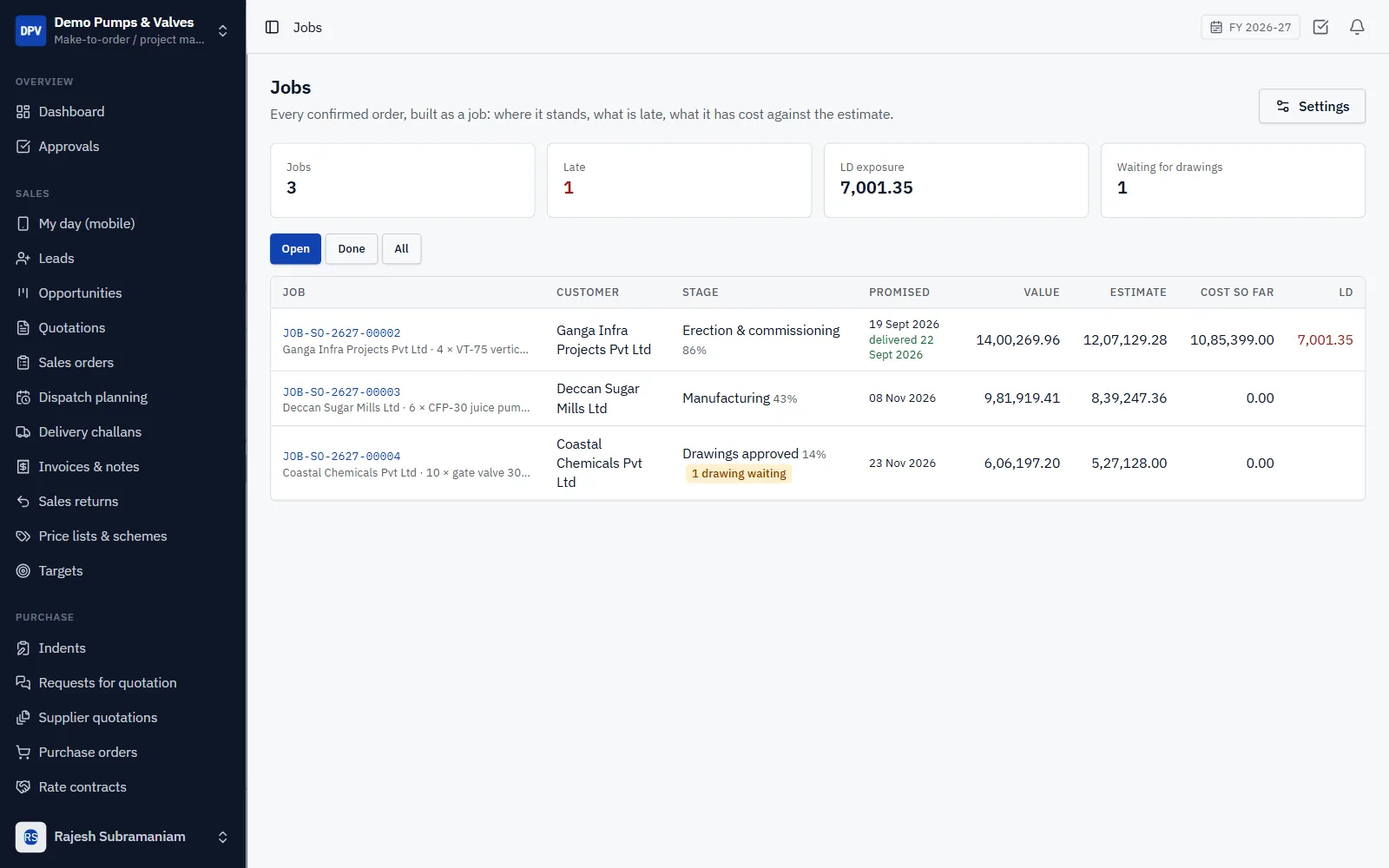
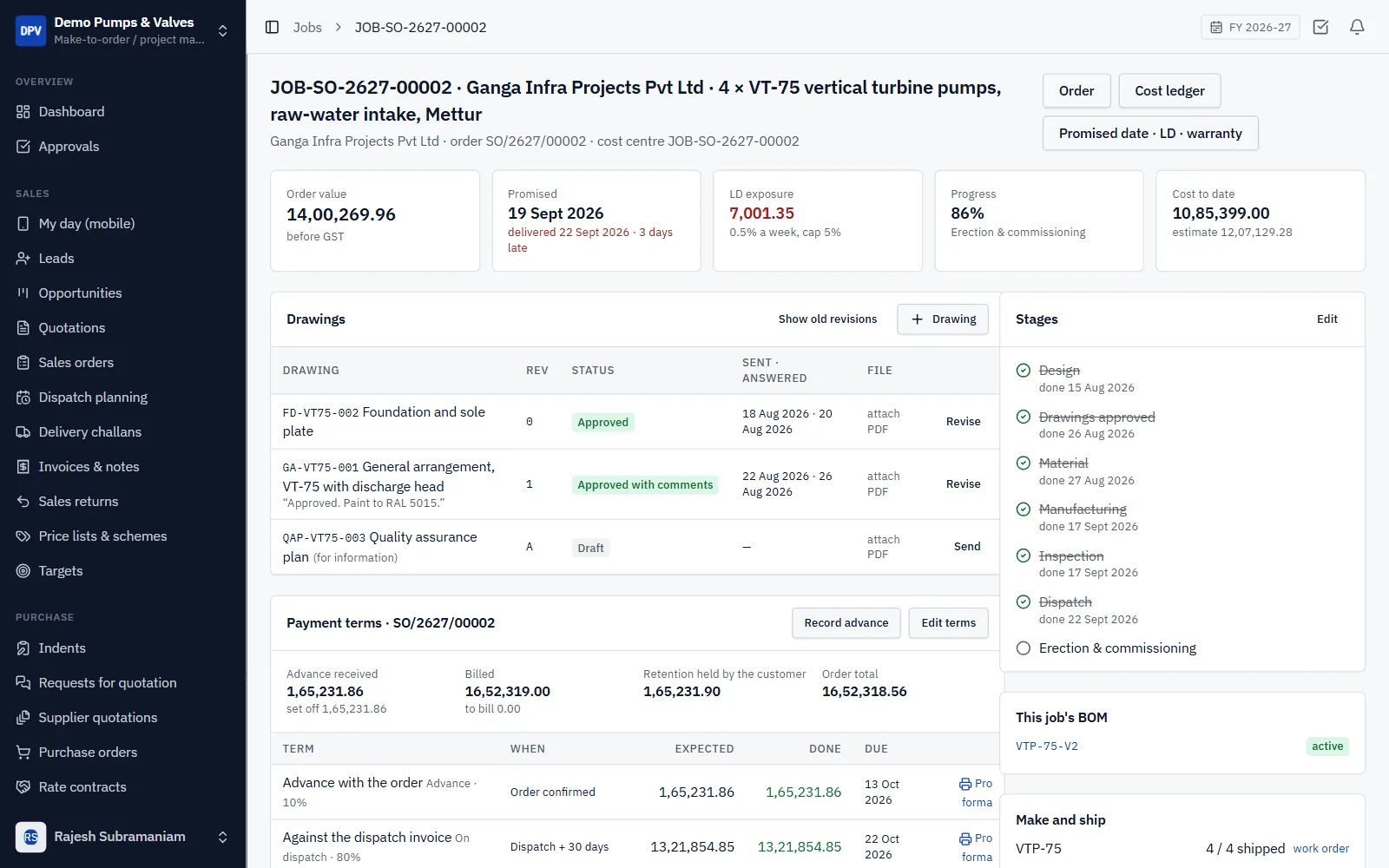
- Made to order: the machines delivered against a job's order now count in the job's cost to date, so cost against the estimate and the margin are right.
- Pharma: a batch that has been dispensed shows what was dispensed, lot by lot, instead of working it out again.
- Pharma: material status lists only the materials you buy in; your own batches are released on the Batches screen.
v1.21.1
2026-10-14
Waiting-room screens for every branch with doctors, and for one-branch hospitals
- A hospital or clinic with one branch now sees its doctors' tokens on the waiting-room screen, also for doctors who have no branch set. Before, that screen stayed empty.
- Online booking & screens offers a screen only for branches where a doctor sits, so a head office with no doctors gets none.
- With several branches, the page names any doctor whose tokens would show on no screen, so you can give them a branch or sittings.
v1.21.0
2026-10-13
Seven more industries: machinery, mills, foundries, packaging, jewellery, pharma and construction
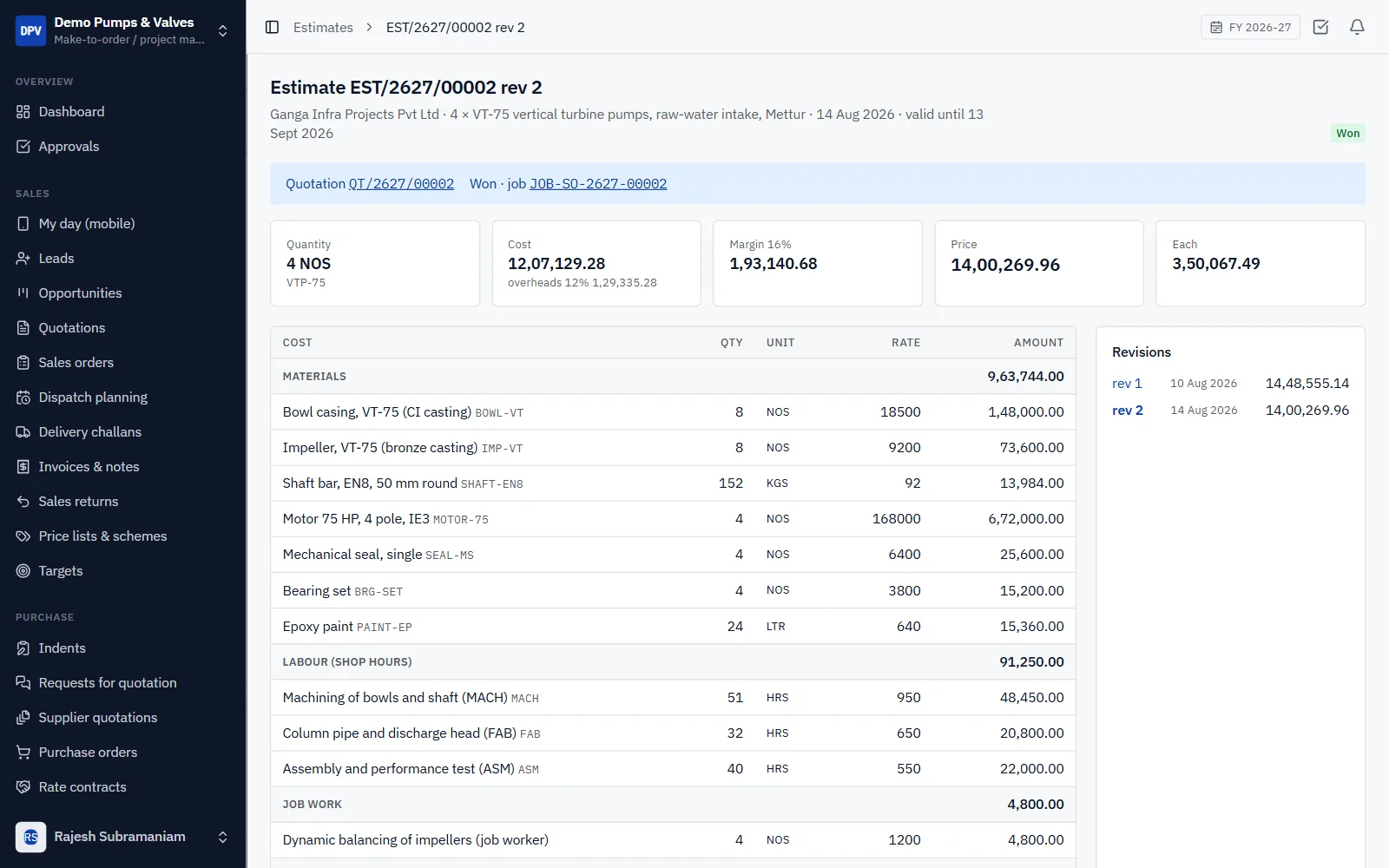
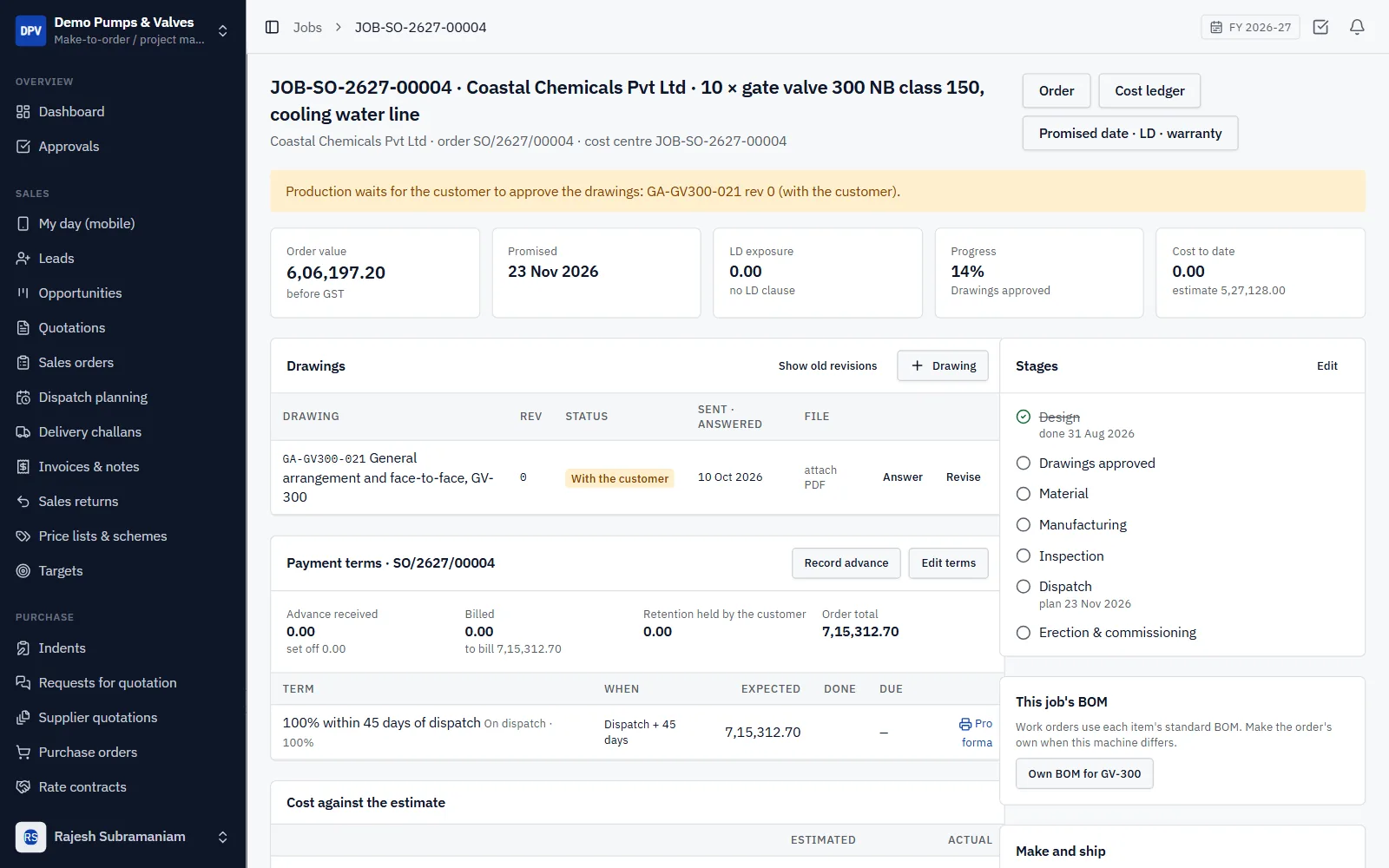
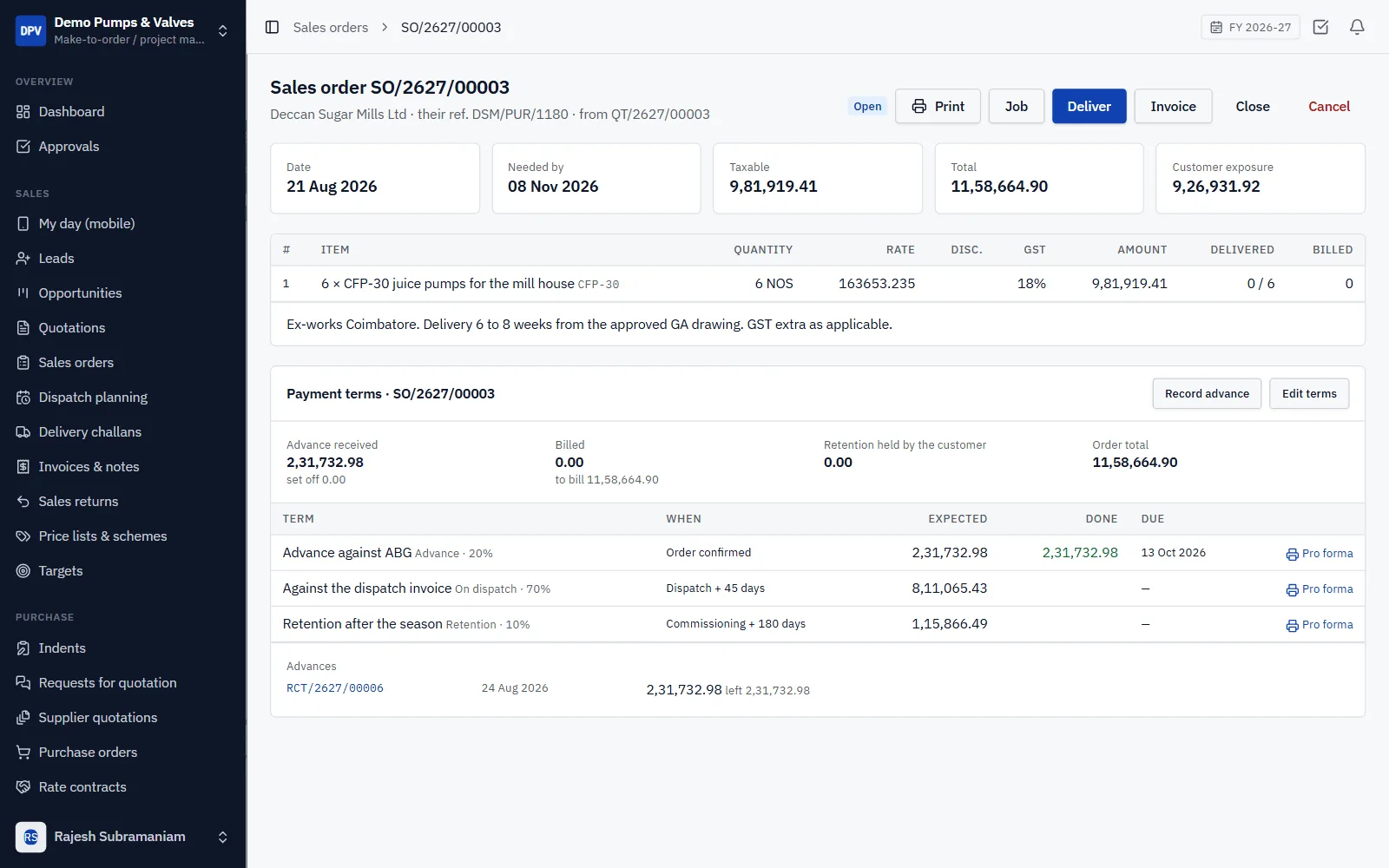
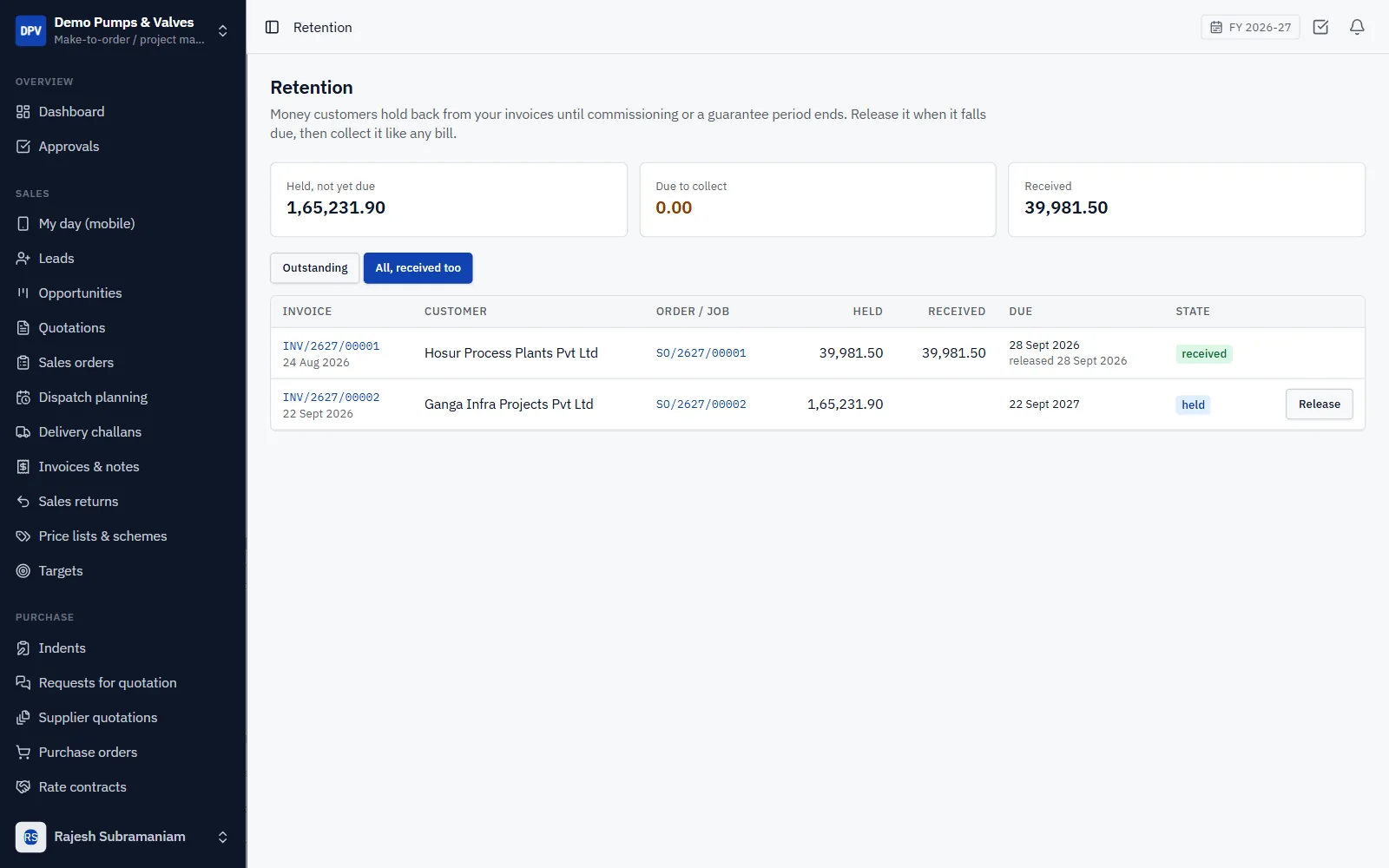
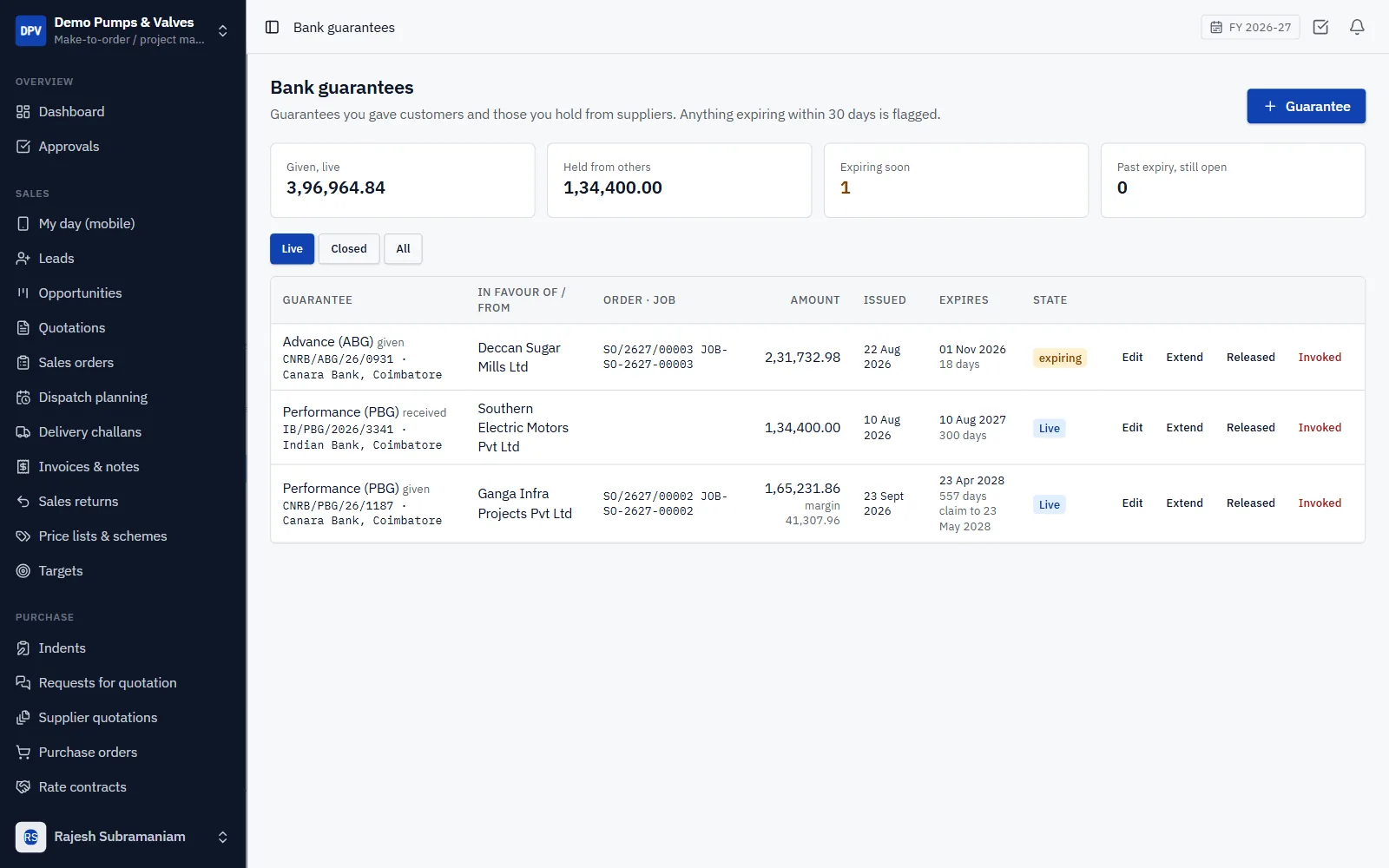
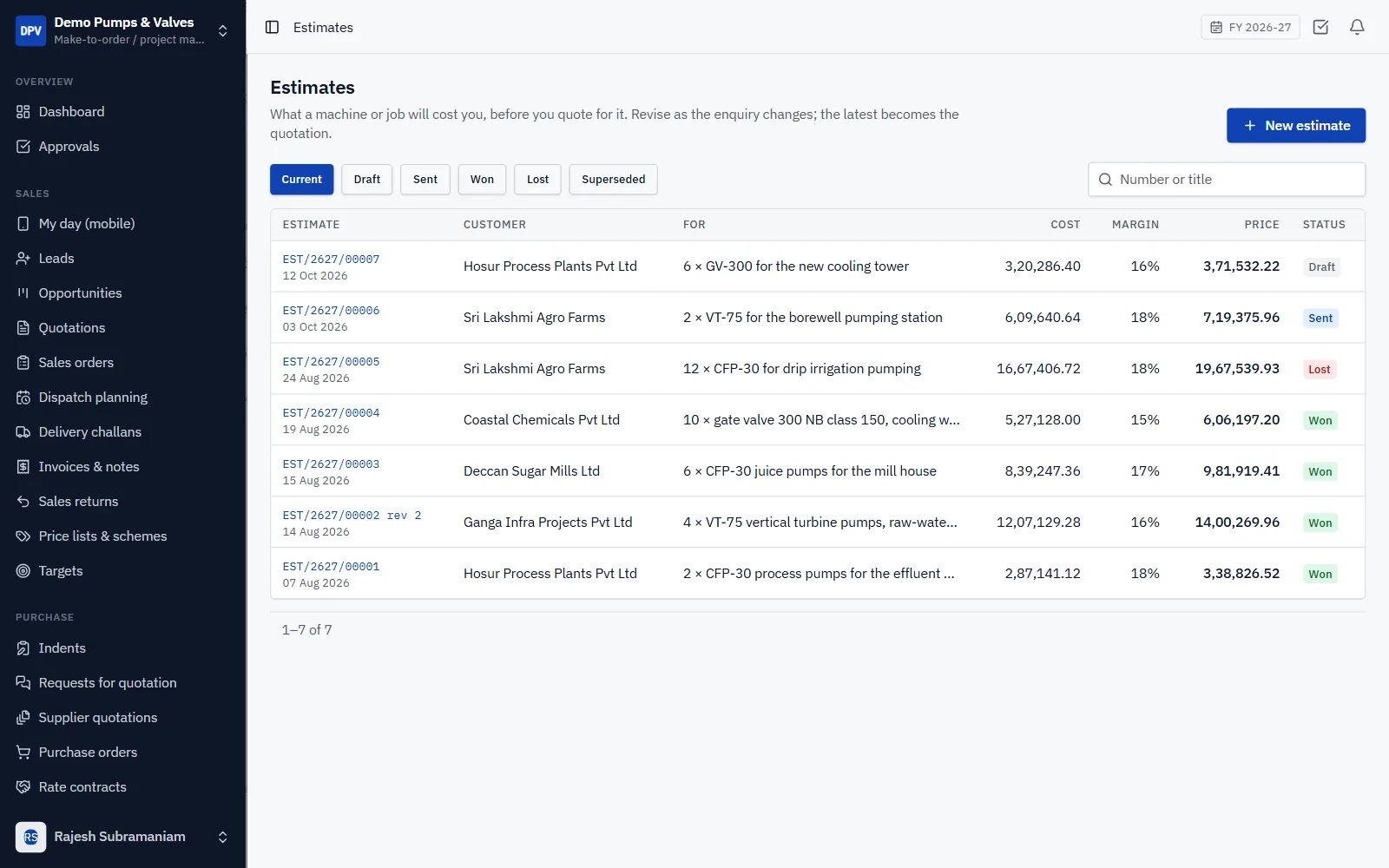
- Made to order: estimates with revisions, every order built as a job with its stages and drawings for the customer's approval, payment terms with advances, milestones, retention and bank guarantees.
- Rice, oil, dal and flour mills: the weighbridge, produce bought by quality with moisture and dirt deducted, lots, milling with the outturn against the recipe, by-products as weighed, and custom milling at an agreed outturn.
- Foundries: material grades, heats with the charge, melt loss and lab results, castings poured with their heat number, rejections by defect, the pattern register and test certificates.
- Packaging and printing: box, carton and pouch specifications with their calculators, estimates and BOMs from the specification, artwork approval before a job is released, dies and plates with their impressions, and wastage per stage.
- Jewellery: metal by purity in fine grams, the day's rates, melting, karigars' metal accounts, tags, hallmarking with HUIDs, billing by weight and customers' metal accounts.
- Pharma: material status with A.R. numbers, master formulas with potency dispensing, batch records done and checked by two people, deviations, yields, packing material reconciliation and QA release.
- Construction: contracts with their BOQ and variations, the measurement book, RA bills with retention, advance recovery, TDS and labour cess, subcontractors' measured bills, the site diary and material reconciliation.
- A tooling register for patterns, dies, plates and cylinders, and artwork kept on an item revision by revision.
v1.20.0
2026-10-13
Clinic Network: a chain of clinics on one patient record
- A new set-up for clinic chains, multi-speciality, dental, eye and physiotherapy clinics with several branches: the OPD, billing, pharmacy and laboratory of the hospital system, without wards.
- Doctors at several branches: say where and when each doctor sits; bookings and walk-ins land at that branch, and the token starts at 1 at every branch.
- Treatment packages: sessions sold at one price, paid in full, ticked off at any branch, given back with a reason; a service taken from a package is never billed again.
- Online booking on your own page, confirmed by a code sent to the patient's mobile from your own SMS account, and a waiting-room screen for every branch that shows tokens, never names.
- A pharmacy in every branch: each visit's medicines leave its own branch's shelf, returns go back to it, and the Schedule H1 register prints per branch.
- A head-office board: patients seen, new patients, revenue, each doctor's consultations and bills, average wait, no-shows, online bookings and packages, branch by branch.
- Hospitals can use the doctors-by-branch sittings, the pharmacy per branch, packages and online booking too.
v1.19.13
2026-10-13
Each invoice keeps the drug licence it was sold against
- A sales invoice keeps the drug licence of the customer as it was when the invoice was made, so renewing a licence later never changes an old invoice.
- Once an invoice is posted, its drug licence cannot be changed.
v1.19.12
2026-10-13
Tax declarations waiting for HR
- The payroll run names every tax declaration HR has not verified yet, so it can be verified and the run recomputed before approval.
- Employees see on their tax declaration whether HR has verified it and whether it is used for the tax taken from their salary.
- Help explains van settlements that wait for approval and calls kept on a salesman's phone.
v1.19.11
2026-10-13
Wholesale to licensed buyers, and the full ERP for checklists
- Record the drug licence number of a customer and its valid-until date on the customer form.
- Schedule H, H1 and X medicines can be sold on an invoice or sales order to a customer whose drug licence is valid on that date; anyone else is still sent to the counter.
- The drug licence of the customer prints on the invoice, its share link and its PDF.
- A checklists workspace can turn on the full ERP again under Configuration, Industry features.
v1.19.10
2026-10-13
Live demo on its own domain
- The live demo runs only on the separate demo domain and still opens inside the page that shows it.
v1.19.9
2026-10-12
Branch access and patient privacy
- Lines of invoices, orders, payslips, loans and clinical records follow the branch access of their document.
- Year close and moving labour cost to projects need access to every branch.
- In pharmacy and hospital companies, Schedule H, H1 and X medicines are sold only through the counter, home delivery or the hospital pharmacy.
- In hospital companies, patients' bills and details are hidden from the general invoice, party and report screens for people without patient or billing access.
- Timesheet cost rates are shown only to people who can see salaries.
- Sign-in cookies are protected against other sites; everyone signs in again once.
v1.19.8
2026-10-12
Counters, vans, HR and approvals security
- A cashier bills into and closes only a till they opened; a manager can still close any till.
- Counter device bills take GST from the item master, never above MRP, and returns refund only what was paid in money.
- A van day settlement and exit settlement payouts wait for your approval rules when they apply.
- Collections, claims, customer jobs and beats follow branch access; leave applications too.
- PAN and bank details are shown only to people who can see salaries.
- Employee tax declarations change TDS only after HR verifies them.
- Attendance for a month whose payroll is approved or paid cannot be changed by import or device.
- Calls and checklist answers saved offline on a phone are sent only under the person who saved them.
- Hospital bill refunds post once, and discharge summaries print only for clinical staff.
- WhatsApp set-up is changed only by the workspace owner, and only bought products can be switched on.
v1.19.7
2026-10-12
Approvals and branch security
- Stock adjustments, payroll runs and employee loans now wait for your approval rules before they post.
- An exit settlement must be posted by someone other than the person who worked out the figures (the owner excepted).
- Documents with no branch are checked against the approval rules of every branch the person works in.
- Only the owner can change how a named approver signs in.
- Recurring invoices, loans and settlements follow branch access.
- Counter bills and loyalty points are checked on the server, and the demo blocks a few more settings.
v1.19.6
2026-10-12
Security fixes
- Workspace-wide Email, SMS and sign-in security settings can now be changed only by the workspace owner.
- Confirming your password checks your own account, also for people who sign in with a mobile number or user ID.
- Roles named Administrator, or used as approvers, can be created, deleted or given out only by the owner or an approvals manager.
- Whole-company payroll runs need access to every branch; branch users run payroll for their own branch.
- Files attached to a branch or warehouse follow the access rules of that branch.
- HR setup lists (salary heads, leave types, shifts, holidays) need their own permissions, and giving an employee a sign-in needs salary access.
- In-patient clinical notes, medication and vitals are shown only to clinical staff.
- Recurring invoices need permission to create sales invoices, and expenses follow your payment approval rules.
- Online payments made with test gateway keys are never recorded as real receipts.
v1.19.5
2026-10-12
Sign in with a mobile number or user ID
- Everyone has their own sign-in: an email, a mobile number or a user ID such as a student number.
- People without a password or email can sign in, or choose a new password, with a one-time code sent by SMS from your own MSG91 account (Configuration → SMS) or by email.
- Add a person with a temporary password they change at the first sign-in, or with a setup link that works once for 72 hours.
- The office can now give a temporary password or a new setup link to someone who forgot theirs.
- Nobody can change how a more senior person signs in: only the workspace owner can, for the owner and for people who also work in another company.
v1.19.4
2026-10-12
Security fixes
- Two-step sign-in codes are counted per account and each code works only once.
- Google sign-in for a work address now needs the Google Workspace account of that company.
- Branch-restricted users can no longer widen their own access, see payroll runs of other branches or read the audit trail.
- Group financial statements include only the companies where you may see reports.
- Counter returns can never give back more than was sold, even from two counters at once; a counter discount above the limit now shows on the price-difference list.
- An invoice keeps its type when edited, and Billing sends only sales documents.
v1.19.3
2026-10-12
Checklists: the right word for a branch on every screen
- Registers, Issues and Report a problem now say store, centre or property in a store, clinic or hotel (they still said outlet), and three messages say branch.
v1.19.2
2026-10-12
Sign-ins stay with your workspace
- A sign-in now only works in the workspace it was made in, and is cleared if it turns up anywhere else.
- Everyone is asked to sign in once more after this update.
v1.19.1
2026-10-11
Checklists: equipment for stores, clinics and hotels
- Outlets, stores, centres and properties can now list display chillers, billing counters, autoclaves, oxygen cylinders, medical devices, pools, laundry machines, lifts, generators, air conditioning and fire safety equipment, so repeat failures are counted on the right piece.
v1.19.0
2026-10-11
Checklists for retail chains, clinics and hotels
- Choose "Retail store chains", "Clinics & diagnostic centres" or "Hotels & guest houses" for a company: it opens straight on its checklists, like Outlet Checklists for restaurants, and the screens speak its language (stores, centres or properties instead of outlets).
- Ready-made checklists for each: store opening and closing, the cash counter, chillers, shelves and prices; clinic cleaning, the autoclave log, the vaccine fridge, biomedical waste and the emergency trolley; hotel front desk, room inspection, linen, pool and night rounds. Your own industry comes first, and every other industry is under More ready-made checklists. All are starting points: check them against your own rules.
- Retail Chain Billing and Pharmacy Chain Billing can switch checklists on under Configuration → Industry features at no extra cost; switching them on now also creates the checklist roles, so a problem reaches the store manager first.
- Help: a new guide, Ready-made checklists by industry.
v1.18.2
2026-10-11
Help shows the guides for the product you bought
- Retail Chain Billing, Pharmacy Chain Billing, GST Invoicing and the hospital now open Help on their own guides and list only the guides for their screens, with buying, stock, GST and settings after them. The full ERP brings every guide back.
- Help → Take the tour now starts the tour again.
v1.18.1
2026-10-11
Outlet checklists: Help shows the guides for your product
- In Outlet checklists, Help opens on the checklists guide and lists only the guides for what you have: building checklists, the phone, reviews and issues, WhatsApp, people and settings. Switch on "The full ERP" and every guide is back.
v1.18.0
2026-10-11
A menu for the product you bought, and a guided tour
- Retail Chain Billing, Pharmacy Chain Billing, GST Invoicing and the hospital now show the menu of that product only: its own screens, with buying, stock, the books and GST behind them. Configuration → Industry features → The full ERP brings every module back.
- A screen listed in two places now shows once, in the first.
- The first time you sign in, a short tour walks through the menu one item at a time, with Next, Back and Skip. Each person gets the tour for their work: the owner, a cashier, a pharmacist, a rider, a salesman or outlet staff.
- Help → Take the tour plays it again; on a phone the tour names where each item sits in the menu.
v1.17.1
2026-10-11
Outlet checklists: one issue for a fault that repeats, and WhatsApp sent only once a change is saved
- A step that fails again at the same outlet while its issue is still open stays on that issue, instead of opening a second one and telling the same people twice. Once the issue is fixed, a new failure opens a new issue.
- WhatsApp messages about a checklist or an issue now go out only after the change is saved, so a slow reply from WhatsApp never holds up handing in a checklist, and nothing is sent about a change that did not go through.
- The menu lights up only the screen you are on (it showed two at once on some screens).
v1.17.0
2026-10-11
Outlet checklists: every outlet run to the same routine, with proof
- Choose "Restaurants & outlet chains" for a company: it opens straight on its outlets and checklists, without the accounts, stock and sales screens (switch "The full ERP" on under Industry features to add them).
- Outlet checklists → Checklists: build a routine once (photos, readings with limits, yes or no, choices, notes, video and voice notes), or start from ready-made restaurant checklists: opening, closing, temperatures, receiving goods, cleaning, pest control, frying oil and staff health.
- Schedules send each checklist to the right people at each outlet every day, on some weekdays or days of the month, with a time it opens, a time it is due by and a late window; a night round can run past midnight.
- My checklists on the phone: one step at a time with the camera and the location, and it works without signal: answers wait on the phone and are sent when the signal is back.
- Every answer is kept with its time and place and cannot be changed afterwards. Checks note a photo that was not taken just now, taken away from the outlet, sent before, too dark or blurred, or a reading outside its limits.
- A failed reading opens an issue for the outlet manager with a deadline; if nobody fixes it in time it goes to the area manager, then the operations head, then the owner. Managers review flagged checklists and send steps back to be done again.
- Outlet checklists → Board shows every outlet today, the last 7 days and each person's on-time rate; Registers print any checklist for an outlet and a month as the paper log an inspector asks for.
- Configuration → WhatsApp: connect your own WhatsApp business number, and your team gets their checklists, reminders and escalations on WhatsApp once each person turns it on from their own phone.
v1.16.0
2026-10-11
Pharmacy chains: medicines by the strip, prescriptions, the H1 register, expiry and home delivery
- Choose "Pharmacy chains" for a company: the retail counters, tills, transfers, prices and loyalty, with what medicines need on top. Each store keeps its drug licences and pharmacist, printed on every bill.
- Pharmacy → Medicines: schedule, salt, strength, form and units in a pack for each medicine, and a master list of about 4,900 medicines to add from (no prices: the MRP comes from your purchase bill).
- At the counter a medicine sells by the strip or the loose tablet: a full strip at its printed MRP, a loose tablet at its share rounded down, never above MRP. "Same salt" shows other makers in stock.
- Schedule H asks for the prescriber; H1 and X also for the registration number and the patient, offline too, and go into the store's register with the bill (Pharmacy → H1 register, printable).
- Pharmacy → Expiry: what expires soon in every store, returned to the distributor against the original bill, moved to another store, or written off once expired. Free goods on a distributor's bill come in at no cost.
- Pharmacy → Home delivery: orders by phone or WhatsApp, riders on their phones (My runs), billed at the door in cash or UPI, each run settled like a till.
- A Pharmacy chain board under Analytics: counter sales, bills, average bill, stock expiring soon and expired, H1 medicines sold and deliveries.
v1.15.1
2026-10-11
Invoices as PDF attachments, and online payment through Cashfree
- Every invoice, quotation and statement you email goes with its PDF attached, in your invoice design; payment reminders and recurring invoices attach it too. Untick "Attach the PDF" to send the link only.
- A PDF button on Share & send, and Download PDF on the customer's link: the same file the email attaches.
- Online payment through your own Cashfree account as well as Razorpay: choose the gateway, enter the App ID and Secret Key, try it in Sandbox and switch to Production. A payment is recorded only when Cashfree itself confirms it, for that order and that amount.
- A customer sent to their bank's own page comes back to the invoice and sees the payment recorded there.
v1.15.0
2026-10-11
GST invoicing and billing: invoices sent as links, paid online, reminded and repeated
- Choose "Billing & invoicing" for a company and open Billing → Billing home: sales, collected, owed, overdue, due this week, paid online and not yet billed, each opening the invoices behind it.
- Billing → Invoice design: your logo, colour, template, bank details and signature, and a UPI scan-to-pay QR for the exact amount still owed on every unpaid invoice.
- Share & send on an invoice, a quotation or a customer: email it from your own account or send it on WhatsApp as a secure link; the customer views and downloads it, and you see when they opened it.
- Customers accept or decline a quotation online, and you are told.
- Online payment through your own Razorpay account: the customer pays from the invoice's link and the payment is recorded and settled against that invoice by itself.
- Recurring invoices made on their dates (drafted, posted, or posted and emailed), and automatic payment reminders before and after the due date.
- Expenses, billed on to customers with a markup, and approved hours billed at the project's rate: on the invoice through Add from, each only once.
v1.14.0
2026-10-11
Retail chain billing for supermarkets and store chains
- Choose "Retail chains" for a company and open your stores under Retail → Stores & counters: each store gets its own shop floor, cash account and counters, and each counter its own bill series.
- The counter: scan barcodes or weighing-scale labels, search by name, hold and recall bills, and take cash, UPI, card and loyalty points on one bill. GST is worked out inside the price, nothing is sold above its MRP and batches go first-expiry-first.
- Pair a counter with its computer and it keeps billing when the internet goes down; the bills are sent in order when it returns, and anything sold beyond the shelf is listed under Counter exceptions.
- Tills: open with a float, count the cash at night, and a manager approves the shortage or excess, which is posted to the books.
- Returns at the counter against the original bill, refunded in cash, UPI or card, with the stock and loyalty points put back.
- Store indents, transfers from the warehouse and receipt at the store; between states the transfer carries a branch-transfer invoice. Reorder suggestions and a blind stock count.
- Store prices: a price list per store, price changes scheduled for a date, and the list of shelves to relabel.
- Loyalty points by phone number, earned on what was paid and redeemed at any store.
- A Retail board under Analytics: sales by store and day, bills, average basket, till differences and counter exceptions, each opening the records behind it.
v1.13.1
2026-10-10
Each customer has its own database login
- Every customer's ERP now connects to its database with a login of its own that can reach no other customer's data, on top of the separation it already had.
- Nothing changes in how you use the ERP.
v1.13.0
2026-10-09
ERP for hospitals and nursing homes
- Choose "Hospitals & nursing homes" for a company and it opens with specialities, roles, a tariff, a pharmacy, a test catalogue and wards ready to edit.
- The OPD: registration with one number for life (UHID), appointments, a token queue per doctor, vitals, consultation notes and prescriptions that are frozen once signed. Every opening of a clinical record is logged.
- Billing at the counter: consultations and services, deposits, discounts within a limit, refunds and a day-end report that ties to the books.
- The pharmacy dispenses against the prescription from the batch that expires first, never above MRP, takes returns and keeps the Schedule H1 register.
- The laboratory: orders from the OPD and the wards, sample numbers, results flagged against your reference ranges, validated by a second person, and printed reports.
- In-patients: a live bed board, admission with a deposit, transfers, medication charts with every dose recorded, rounds and nursing notes, the theatre list and insurance pre-authorisation.
- The final bill counts bed-days at midnight and holds every visit, procedure and operation; the doctor signs the discharge summary from the stay.
- A Hospital board under Analytics: in-patients now, bed occupancy, average length of stay, OPD visits and revenue by department, each figure opening the records behind it.
v1.12.1
2026-10-09
A fuller distributor demo
- The distributor demo company now has three salesmen on six beats with about 120 shops, a van, cheques and claims, all made through the product itself.
- A salesman sign-in on the demo opens the salesman's phone app: today's beat, orders, van sales and collections.
v1.12.0
2026-10-09
Principals, market returns and claims
- Give each item its principal (the brand owner), and mark the trade schemes the principal pays back.
- Record market returns line by line as saleable, damaged or expired. Damaged and expired goods are held for the claim.
- Build claims on a principal from the books: schemes given (free goods and discounts on the bills), expired and damaged goods, and price drops on stock. Send them, then settle each with the principal's credit note or mark it rejected. The books follow at every step.
- Secondary sales per principal: by month, outlet, beat and item, with a CSV to send them.
v1.11.0
2026-10-09
Van sales
- Set up a van as a warehouse, with its vehicle and its salesman, and load it from the godown in the morning.
- The salesman bills shops straight from the van on the phone: priced like an order (schemes, free goods, MRP), paid by cash, UPI, cheque or on credit within the shop's credit rules. Without signal the sale waits on the phone and is billed once.
- Unload what comes back, then settle the day: count the van, enter the expenses and the cash handed over. Count differences, cash short or over, receipts and expenses are all posted in one step.
- A van takes no new load until its last day is settled (can be switched off).
v1.10.0
2026-10-09
Load sheets, refused goods, cheques and collections
- Print a load sheet for a trip: every item and batch on its challans added up, with cases and MRP, to load the van from one list.
- Goods a shop refuses at the door become a draft credit note against its invoice in one step. Posting it brings them back into stock.
- Record cash, UPI and cheques where they are taken, on the salesman's phone too (kept on the phone without signal). The office posts them to the customer's oldest bills, and each person has a day-end sheet.
- Post-dated cheques wait until their date. A bounced cheque opens the bills again, can put the bank charges on the customer, and can put the customer on credit hold.
- Credit control: hold new orders from a customer whose oldest bill is too many days late, or who has too many unpaid bills.
v1.9.0
2026-10-09
Free goods, order-value discounts, MRP and cases
- Trade schemes now also give free goods ("buy 12, get 1 free", or another item free) and a discount once an order reaches a value. They are applied to orders by themselves, and free goods go to the challan and the invoice at nil value.
- Give items their MRP: nothing is sold above it, each received lot keeps the MRP printed on it, and prints show it under every line.
- A selling price list can be "MRP less x%", with GST taken out of the MRP.
- Items sold in cases are ordered as cases plus loose pieces, on orders and on the salesman's phone, and prints show both.
v1.8.2
2026-10-09
The sidebar keeps its place
- Scroll down the menu on the left and open a page: the menu now stays where you left it, instead of jumping back to the top.
v1.8.1
2026-10-09
Email from your own account
- Set up your email under Configuration → Email: your SMTP server (Gmail, Zoho, Microsoft 365, your web host) or your Brevo API key.
- Password reset links and scheduled reports now go out from your own address, and a test email checks the set-up.
- Until email is set up, the Forgot password page says so and scheduled reports pause with the reason.
v1.8.0
2026-10-09
Beats and the salesman's phone
- Put your shops on beats: the round each salesman makes, on which weekdays, in visit order, with each shop's outlet type.
- On the phone, a salesman opens today's beat and, at each shop, sees what it owes and how late, its credit and its last order, then takes an order or notes why there was none.
- Orders from the phone are priced from the shop's own price list and schemes, ship from the beat's warehouse and follow your credit limits and approval rules. No signal? The call is kept on the phone and sent when the signal is back.
- The beat report shows each salesman's planned shops, coverage, productive calls, lines per call and order value, and Targets can set productive calls for the month.
v1.7.1
2026-10-09
Every industry has its own company in the live demo
- The process manufacturing ERP's live demo opens a spice maker: recipes made in batches, a by-product, every lot with its expiry date, incoming and batch-release quality checks, and the grinder's monthly maintenance.
- The trading and distribution ERP's live demo opens an FMCG distributor: stock by lot and expiry, a second godown, trade schemes applied to orders by themselves, a wholesaler's own price list and a commission agent.
- Each listing now opens its own industry, so a buyer sees work like theirs from the first screen.
v1.7.0
2026-10-08
Job work for customers
- Dye, print, compact or stitch a customer's own material: receive it roll by roll and lot by lot, kept on its own register and never in your stock or books.
- Send back processed goods saying how much of their material they took, so the process loss shows on every job, and return unused material too.
- Print the inward acknowledgement and the return challan, see what you hold of each customer and since when, and bill your charges in one click.
v1.6.2
2026-10-08
Fixes to style orders and ITC-04
- The style orders list shows how many each order makes again.
- ITC-04's position with each job worker is dated today, not the end of a period that has not ended yet.
v1.6.1
2026-10-08
A textile company in the live demo
- The textile ERP's live demo opens a knitwear maker: styles in sizes and colours, fabric rolls and dye lots, knitting and dyeing at job workers, style orders, agents' commission and packing lists, with two months of its work.
v1.6.0
2026-10-08
Agents' commission and GST by price slab
- Agents and brokers: give a customer its agent and a commission rate; orders and invoices carry them.
- See what each agent has earned, as customers pay or as invoices are raised, what they have billed, and what is due.
- Make the agent's commission bill in one step, with GST and TDS under section 194H.
- GST by price slab: enter the slabs your CA confirms, by HSN and date, and every order and invoice line takes the right rate for the value of a piece.
v1.5.0
2026-10-08
Style orders and job work by the roll
- A style's BOM: fabric in each garment's own colour, and a quantity per size.
- Style orders: order a style in a size and colour grid, and get a work order for each, from one BOM.
- Issue fabric to a whole style order at once, roll by roll, shared out by what each size needs.
- Every size and colour of one fabric comes from one dye lot across the whole order.
- Job work with rolls: say what the job worker used and returned, roll by roll, and give dyed rolls their dye lot.
- Process loss at each job worker against what the BOM allows, flagged when it goes over.
- ITC-04 shows what is still with each job worker, losses, and challans pending for nearly a year.
v1.4.0
2026-10-08
Fabric rolls and dye lots
- Each fabric roll is kept on its own, with its length, weight, dye lot, shade and width.
- Receive rolls by pasting the supplier's packing list into a goods receipt.
- What is left of a cut roll shows in both metres and kilograms.
- 4-point inspection: type a roll's defect points and see them per 100 square yards, checked against your limit.
- One fabric is issued from one dye lot, so a garment never shows two shades; mixing lots on purpose needs a permission.
- Stock by dye lot, and bales with gross and net weight on the challan's packing list.
v1.3.0
2026-10-08
Styles in sizes and colours
- Add a style once and make every size and colour from it: each one is an item with its own stock, code and barcode.
- Size grid on orders, invoices, bills, goods receipts and challans: type a quantity per size and colour and get one line for each.
- Price a whole style in a price list once; a size with its own price keeps it.
- The style page shows stock as a size × colour grid, and changes to a style reach its sizes and colours.
- Printed orders, invoices and challans end with a size breakdown.
- Print barcode labels for an item or every size and colour of a style.
- Textile companies start with sizes, colours, item groups and fabric fields; others can load them under Industry features.
v1.2.0
2026-10-04
Report a bug and Request a feature, step by step
- Report a bug and Request a feature are now two separate guided forms, three short steps each.
- A bug report asks what happened, what you did just before and how much it affects you, and notes the screen you were on.
- Attach up to five screenshots: pick them, drag them in, or paste straight from the clipboard. Large images are shrunk for you.
- Help & guides has a new Getting help page that walks through both forms step by step.
v1.1.0
2026-10-04
Help, feedback and your own web address
- Help & guides: step-by-step pages for getting started, selling, buying, stock, production, GST, payroll and security, inside the app.
- Report a bug and Give feedback go straight to the team that builds the product, with a reference number.
- What's new lists every release, and a notice offers to reload when a new version arrives while you work.
- Use your own domain: the owner connects it under Configuration → Web address.
- The ERP carries your provider's name throughout.
v1.0.0
2026-10-04
First release
- Finance and GST: double-entry books, GST invoices and notes, GSTR-1 and GSTR-3B data, GSTR-2B matching, TDS, bank reconciliation and Schedule III statements.
- Sales and purchase: leads to invoices, indents to three-way-matched bills, price lists, schemes and credit limits.
- Inventory: warehouses, bins, batches with expiry, serial numbers, transfers, counts and reorder levels.
- Manufacturing and quality: bills of materials, MRP, work orders and job cards with actual costing, job work and inspections.
- People: attendance, leave, payroll with PF, ESI and professional tax, ECR, Form 16 and employee self-service.
- Plant maintenance, project job costing, logistics with proof of delivery, dashboards, a report builder, and customer, vendor and dealer portals.